The Great Gatsby

In F. Scott Fitzgerald's novel, Gatsby and Nick live in West Egg, the Buchanans live in East Egg, and Jay spends many a night gazing across the bay at the green light at the end of Daisy's dock.  But what separates Jay from Daisy is more than water.

Fitzgerald's imaginary locations were based on places he knew.  The action is in Long Island, in the road to New York, and in the city itself.  West Egg is Great Neck (at Kings Point); East Egg is Port Washington (at Sands Point), and tonight we spend on a mooring almost in the middle between the two, in Manhasset Bay, Gatsby's impassable gulf.


The map is interactive.  Pan east to see Oyster Bay; pan west to see New York.

Late lunch on a rainy day

Peregrinus came with a full Amel-branded dinner set in melamine, a dinnerware material that evoked memories of childhood among the crew.  It is not ideal for microwave use because it warms up as quickly as the food itself, but otherwise it is perfect for a boat: it is light, resistant to breaking or chipping, and looks great after repeated use.  One day in the children's department at Arango in Miami we came across these melamine Alphabet plates and bowls, and snapped a set right away.  These are made by Design Letters, which secured permission from the Arne Jacobsen estate to use the font he designed in 1937 for the City Hall in Århus.

The serving fountains are Alessi’s Programma 8, by Franco Sargiani and Eija Helander, a collection originally designed in the 1970’s and extended in 2005.  Aside from being rational design pieces, these are practical because they go from oven to table to dishwasher.  The Programma 8 tray, not shown, is ideal for carrying all the pieces in one trip when dining on deck.

Notice there’s no wine on the table?  We are beginning to run out!

The forest in the sea

Yesterday we flew a fourth sail for the first time: the mizzen ballooner, as it is known in the U.S.  The French, however, call it the foc d'artimon, which translates mizzen jib.  In Spanish: foque de mesana.  But in reality it is a mizzen spinnaker, and like any other spinnaker, one must fly it as one might a kite, yet this one almost flies itself.

The months of exercise on Slangevar and Rumble Bee held us in good stead.

In this photo, you can see deployed the mizzen sail at left, the main sail center, foreground, and the ballooner behind the main sail.  Not pictured: the genoa sail flying forward of this small forest of cables, ropes, antennas, spars, and cloth.

This sail is quite uncommon.  It can only be used when the wind blows from 80° to about 170°, i.e. the wind flows from about perpendicularly to almost from behind in relation to the direction of travel of Peregrinus.  Also, winds should not exceed 15 miles per hour.

We had a sailboat under power come and circle us completely as we sailed East under four sails yesterday in Long Island Sound.  Guess they wanted to have a peek.

Unlike our other sails, which are new this year, this one is vintage 2002.  The colors have bled.

Sunset in Woods Hole today

From the aft deck of Peregrinus.  

We celebrated our arrival with fresh Scituate-sourced sushi prepared by chef the Captain.

Tea party town

The original Party took place in 1773 but we celebrated our arrival to Boston yesterday by figuratively dumping the contents of a satchel of Earl Grey.

And it has to be figurative because (1) this is a no-dumping zone, (2) the EPA and the Coast Guard are known for having no sense of humor, and (3) this is a public log.  

Heh.  One wonders what Samuel Adams might think if he knew that dumping a bit of tea in the harbor is again illegal?

image.jpg

Grace

Janet and Tony, she originally of Reading in Berkshire and his family from Northamptonshire, made themselves our hosts in Gagetown and environs (we even spent a wonderful evening rafted up behind Ox Island, near Oromocto).  We are inspired by their creativity, craft, warmth, and energy.  

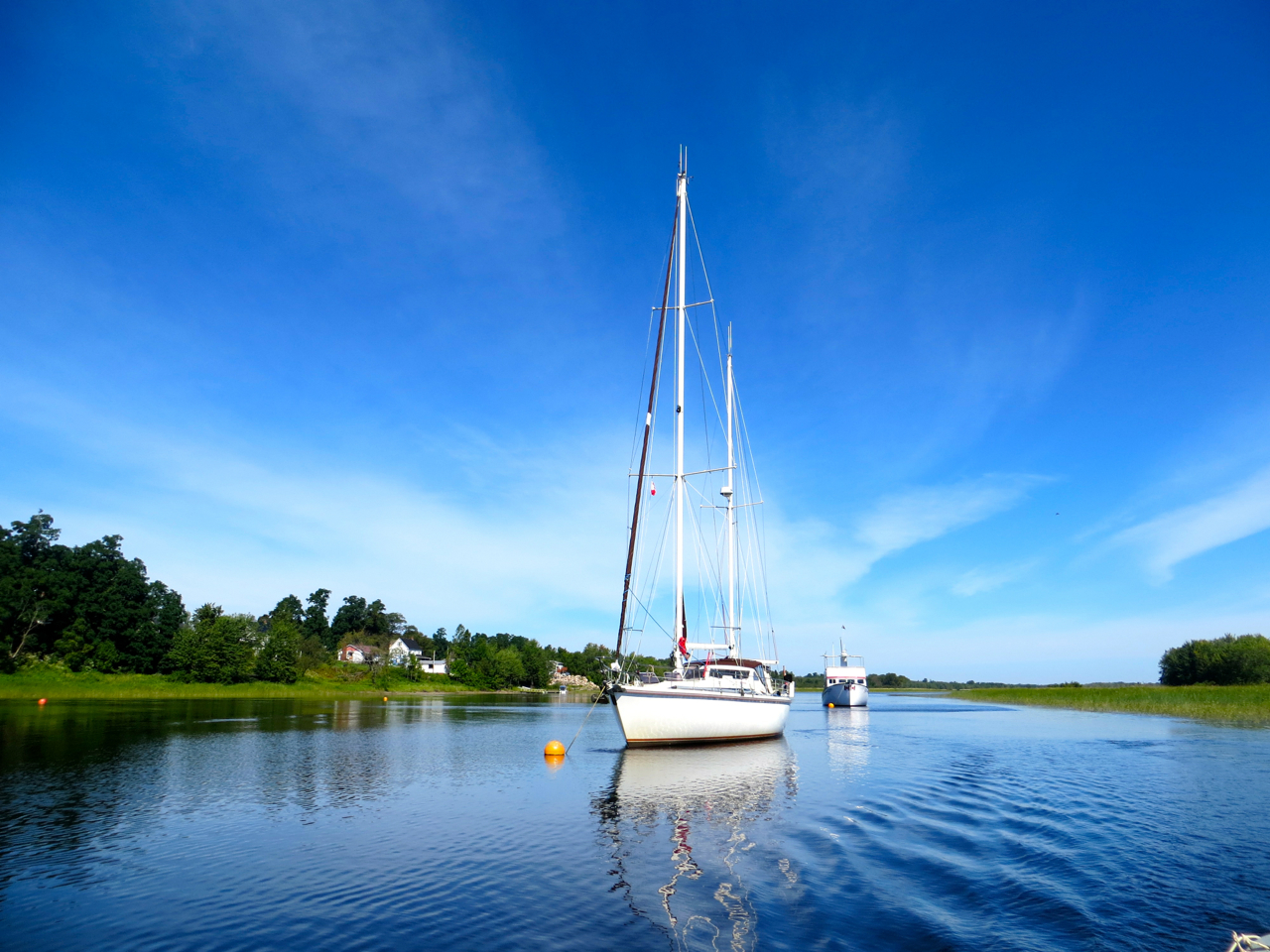
Janet took this picture of Peregrinus from the deck of the Thomas Gage and sent it to us recently.

Peregrinus in the mooring field at Gagetown Creek, Saint John river.  Photo by Janet Ratliffe from the Thomas Gage as it departed on yet another exploration of the river, 10:25 AM 4 September 2014.  Canon PowerShot SX240HS, …

Peregrinus in the mooring field at Gagetown Creek, Saint John river.  Photo by Janet Ratliffe from the Thomas Gage as it departed on yet another exploration of the river, 10:25 AM 4 September 2014.  Canon PowerShot SX240HS, ISO 100, 1/1250".

With Brio

Leah and John kept one of our favorite blogs as they traveled from Mexico, around the Pacific and Atlantic coasts of Central America, and all the way to Maine this year aboard Brio.

We had a fun time meeting them aboard Peregrinus in Bailey Island, Casco Bay, and we look forward to meeting them again across the pond!

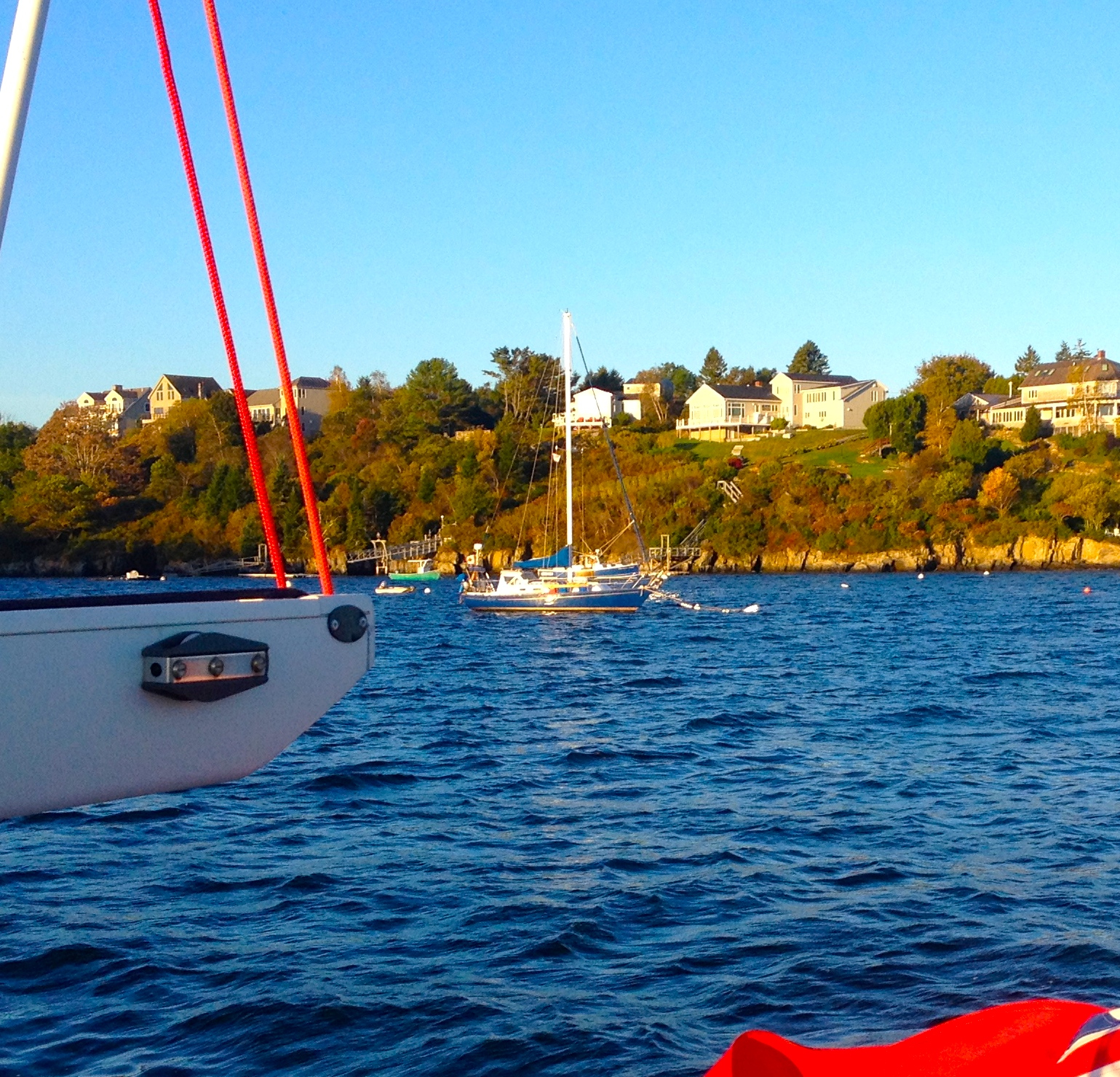
Brio as seen from Peregrinus' stern as it departs from Waier Cove, Bailey Island.  This was our last stop in Maine as we headed South.  7:26 AM 3 October 2014.  iPhone 4S, ISO 50, 1/849"

Brio as seen from Peregrinus' stern as it departs from Waier Cove, Bailey Island.  This was our last stop in Maine as we headed South.  7:26 AM 3 October 2014.  iPhone 4S, ISO 50, 1/849"

A review and comparison of Canadian charts

Before we sailed to Canada, we had to get navigational charts.  We found the following options:

  • Navionics iPad: Navionics Plus vector charts of all of Canada including Northern Territories to Baffin Island (!): $5.
    • This price point comes from purchasing "US & Canada" for $54.99 instead of "USA" for $49.00
  • Garmin BlueChart for iPad: All Canada East Coast to N Labrador as vector charts: $15
    • Includes Canada West Coast and Great Lakes as well as Mexico, Central America, Colombia and the Caribbean.  The $15 price point comes from purchasing "North America" for $44.99 instead of just "US Coastal" for $29.99.
    • This we already had, because when we bought the Garmin BlueChart for iPad we saw the best value is purchasing the $44.99 pack. 
  • TimeZero by MaxSea for iPad:  Raster Charts Canada Mega Wide – All Canada Hydrographic Service West Coast, Great Lakes and East Coast to SE Labrador, consisting on several hundreds of raster charts: $53.36
    • This is the technology found on Furuno TZtouch chart plotters.
  • Navionics for B&G Zeus: Navionics Plus vector charts of all of Canada including Northern Territories to Baffin Island (!): $179.
  • iNavx iPad: Canada Hydrographic Service Nova Scotia South/Bay of Fundy RM-ATL06 chart package, consisting of 77 raster charts: $179.95.
    • Does not include Canada West Coast nor Great Lakes nor Nova Scotia North/PEI/Gulf of Saint Lawrence/Newfoundland/Labrador/Northern Territories, which would be over $1,000 additional.

The best charts are raster and therefore the winners are TimeZero for iPad and iNavx for iPad, which offer the only raster options and the only ones that are the official Canada Hydrographic Service.

The most robust solution is Navionics Plus for B&G Zeus because electric power, screen brightness and dimmability, water intrusion protection, and mount quality of our B&G chart plotters is superb when compared to iPad.  Navionics apparently sells one version of its charts for B&G Zeus 12 and another for B&G Zeus Touch 7: do we have to buy this stuff twice?

The best user interfaces are all iPad and the best is TimeZero for iPad.  Second best might be Navionics for iPad or Garmin.  iNavx is pretty awful for an iPad app.

The best coverage is Navionics.  It covers some pretty far out territory into the Arctic that is the stuff of dreams.  Next are, in order, Garmin (to North Labrador) and TimeZero (to South Labrador only).  Mind you, we traversed as much of the Labrador coast as is possible to do by car, and we saw exactly one sailing boat and it was at the southernmost point of Labrador, so it's not like it makes much of a difference.  The iNavx solution for $179.95 gives you a modest slice of Canada; essentially the Bay of Fundy.  On the other hand, it could provide you the most extensive coverage available anywhere, even beyond Navionics, but at a cost into the thousands of dollars.

In the end, we sailed in Canada, including inland waters, with two iPads open at all times: with TimeZero by Max Sea for iPad because it embodies the best combination of official CHS raster charts, user interface, and price.  We also sailed with Garmin BlueChart for iPad.  Both apps were installed in both iPads, but the Admiral preferred Garmin and the Sailor preferred TimeZero.


Note: In addition to the superb user interface of TimeZero, the Sailor likes MaxSea because they were originally MacSea since the 1980's.  Great pioneers in electronic navigation, all Macintosh-based.


The MaxSea display on iPad, showing the Canadian Hydrographic Service raster charts for the Reversing Falls.  Observe here the amazing quilting MaxSea makes: Saint John proper is a detailed inset, seamlessly blended into the larger-scale chart …

The MaxSea display on iPad, showing the Canadian Hydrographic Service raster charts for the Reversing Falls.  Observe here the amazing quilting MaxSea makes: Saint John proper is a detailed inset, seamlessly blended into the larger-scale chart visible in the  upper left.  This way MaxSea always shows the highest available detail, relieving the user from having to manage or handle charts and chart insets like iNavx does.  MaxSea displays tide heights: see 27-ft tide chart available by pressing the yellow icon.